
11:00 am – 1:00 pm
Italian Academy, 5th floor seminar room
Emily Mackil
University of California, Berkeley
Credit, Debt, and Servitude in Fourth-Century BCE Halikarnassos
Abstract
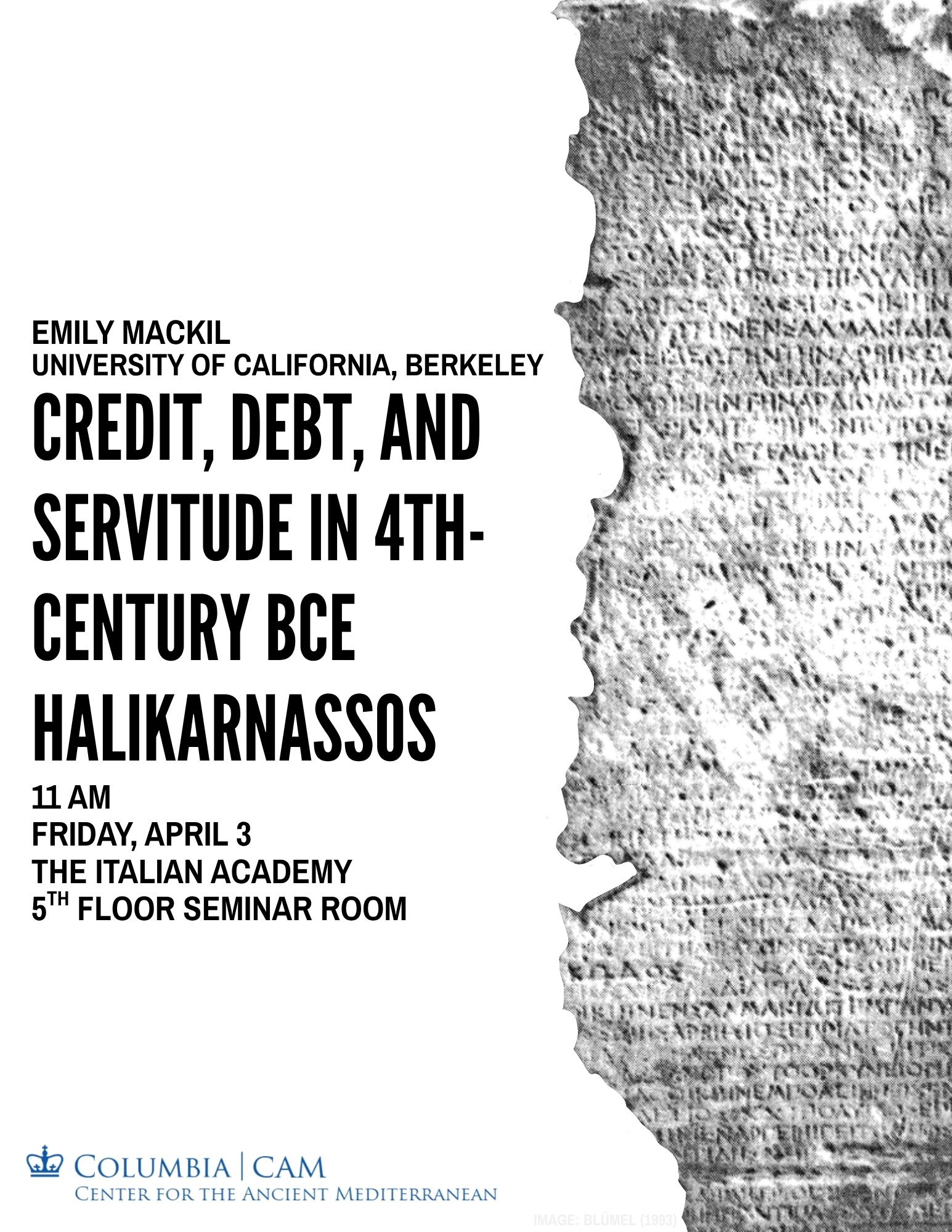
This paper presents the findings of a new edition of SEG XLIII 713, a stele inscribed on four sides with records of the sales of property and persons indebted to Apollo, Athena, and Parthenos at Halikarnassos. Long known but poorly understood and little discussed, the text is currently assigned to the astonishingly imprecise period c. 425-350 BCE. This paper explains the stele’s provenance and modern history and provides an overview of the two kinds of transactions recorded on the stone. The new edition sheds fresh light on a set of paratextual signs that had not previously been detected, as well as on the multiple rasurae that mark the stone. The paratextual elements illuminate the process of transforming diverse archival records—originally kept on perishable materials—into a unified epigraphic document. The erasures, by contrast, are best understood in relation to the monument’s symbolic role and to the evolving histories of debt that the stele momentarily fixed in stone. A fuller understanding of the monetary background of the loans recorded here not only allows us to gauge the scale of the credit operations recorded on four sides, but also offers a strong indication that the document should be associated with the synoikism of the city under Maussollos, ca. 375–370 BCE. The document exposes the economic and social precarity induced by certain forms of debt, and appears to record debt servitude, a practice that is occasionally referenced by contemporary literary sources but is poorly understood by historians. More broadly, this text should be part of the emerging history of the economic transformation of western Asia Minor (and its costs) from the very early fourth century onward, but it has not yet been recognized as such.
